
Material Passports (MP) enable a combined assessment of life cycle assessments (LCA) and circularity assessment of buildings. Semantically rich models, such as Building Information Modeling (BIM), facilitate deriving consistent and automated quantity take-offs of the relevant components for calculating whole building life cycle assessment (LCA). Nevertheless, for automating the BIM-based LCA and circularity assessment processes, there is still a time-consuming effort needed for the manual matching of material and element information.
To close this gap, we propose a method of automatically matching BIM elements and materials to the relevant datasets in LCA and circularity databases using Large Language Models (LLM) and Semantic Textual Similarity (STS). The method matches the semantically most similar environmental dataset to every IFC material or element, to enrich further information about LCA and circularity aspects.
After analyzing and selecting the most suitable LLM, we are fine-tuning the LLM through different strategies, such as adding domain-knowledge e.g. abbreviations, testing different loss functions, or applying different labeling. For the training datasets, we use previously manually matched pairs of datasets from several real-world case studies, as well as abbreviations usual to the AEC domain.
Combining different strategies for fine-tuning pre-trained LLM significantly increases the accuracy of the proposed method of matching BIM elements and materials to environmental material datasets.
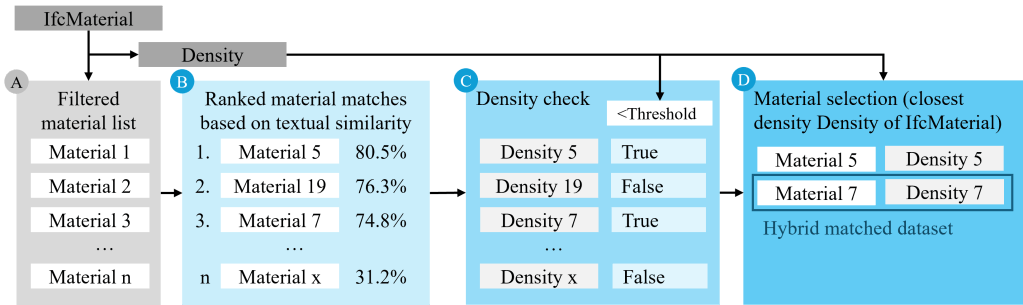
In another study, we propose a hybrid approach that combines text-based and ontology-based similarity matching to enable an enrichment of material properties relevant to BIM-based environmental assessments. It proposes to match EPDs for LCA and thermal properties for BEPS. We then validated the method prototypically with a case study. Using textual and semantic similarity matching of material information increases the robustness of assessment-specific material matching to BIM models. It follows a systematic knowledge structure of building decomposition, material typology, and property classification.
More information here and here.
In collaboration with:
- LIST Eco GmbH
- Madaster Germany GmbH
- TU Eindhoven
Publications:
- Forth, K.; Kaltenegger, J.; Petrova, E.; De Wolf, C. : BIM-based material property enrichment using textual and semantic similarity matching. SBE25 2025, Zürich, Switzerland
- Forth, K.; Berggold, P.; Borrmann, A.: Domain-specific fine-tuning of LLM for material matching of BIM elements and Material Passports. Proc. of 2024 ASCE International Conference on Computing in Civil Engineering, 2024
- Forth, K.; Borrmann, A.: Semantic enrichment for BIM-based Building Energy Performance Simulations using Semantic Textual Similarity and fine-tuning multilingual LLM. Journal of Building Engineering, 2024 DOI: 10.1016/j.jobe.2024.110312

 Kasimir Forth
Hinterlasse einen Kommentar